Medically reviewed by:

I've lost count of the number of patients who've sat across from me having already tried everything. Calorie counting, meal replacement shakes, gym memberships that fizzled out after six weeks. They're exhausted by all of it. If that sounds like you, you're not alone and more importantly, you're not starting from scratch. You're starting from experience, which is worth far more than people give it credit for.
What follows is a Mounjaro (Tirzepatide) step by step guide built from what we've actually seen work with real patients in real UK clinics. Not theoretical outcomes pulled from press releases. Not influencer hype. This is the kind of honest, practical Mounjaro (Tirzepatide) weight loss guide we wish every patient could read before their first appointment.
Right. Let's get into it.
What Is Mounjaro and How Does Mounjaro Work?
Mounjaro (Tirzepatide) is a weekly injectable prescription medication that works on two gut hormones simultaneously: GLP-1 and GIP. Most weight loss injections you've heard of only target GLP-1. Mounjaro (Tirzepatide) targets both and that dual action is precisely why the clinical data is as striking as it is.
So how does Mounjaro (Tirzepatide) work in practice? After injection, the medication mimics these two hormones, which do several things at once. They slow gastric emptying, meaning food stays in your stomach longer and you feel full sooner. They dial down appetite signals in the brain. And they appear to improve how your body handles insulin and blood sugar, which directly affects fat storage.
The upshot? Most people eat less without white-knuckling their way through the day. You still make choices. The medication just turns down the volume on the noise that relentless background chatter about food that so many of my patients describe.
You inject once a week, same day each week, in the thigh, abdomen, or upper arm. The pen comes pre-filled. Ten seconds, roughly. No daily pills, no complicated routine.
Who Is a Good Candidate for Mounjaro?
Not everyone qualifies.
That's actually a good thing.In the UK, prescribing criteria for Mounjaro (Tirzepatide) weight loss UK typically require a BMI of 30 or above, or a BMI of 27+ with at least one weight-related health condition, high blood pressure, sleep apnoea, among others.
The same drug as Mounjaro (Tirzepatide) was originally licensed for type 2 diabetes management, but its weight loss effects have been so remarkable that it's increasingly prescribed specifically for weight management.
Here's what we see in practice: the people who do best are those who've genuinely struggled with appetite regulation. If you can't stop thinking about food between meals, if portion control feels like a losing battle, if you've lost weight before only to regain it every single time this medication was designed for your biology.
But a medical consultation isn't optional. It's the foundation.
A prescriber needs to review your medical history, current medications, thyroid function, pancreatic health, and mental health before writing a prescription. Anyone offering to sell you Mounjaro without that screening is cutting corners you can't afford to have cut.
The question "is Mounjaro (Tirzepatide) safe for weight loss in UK" comes up constantly. The answer: yes, when prescribed appropriately by a qualified clinician who monitors your progress. That's the non-negotiable part.
Your Step-by-Step Mounjaro Process
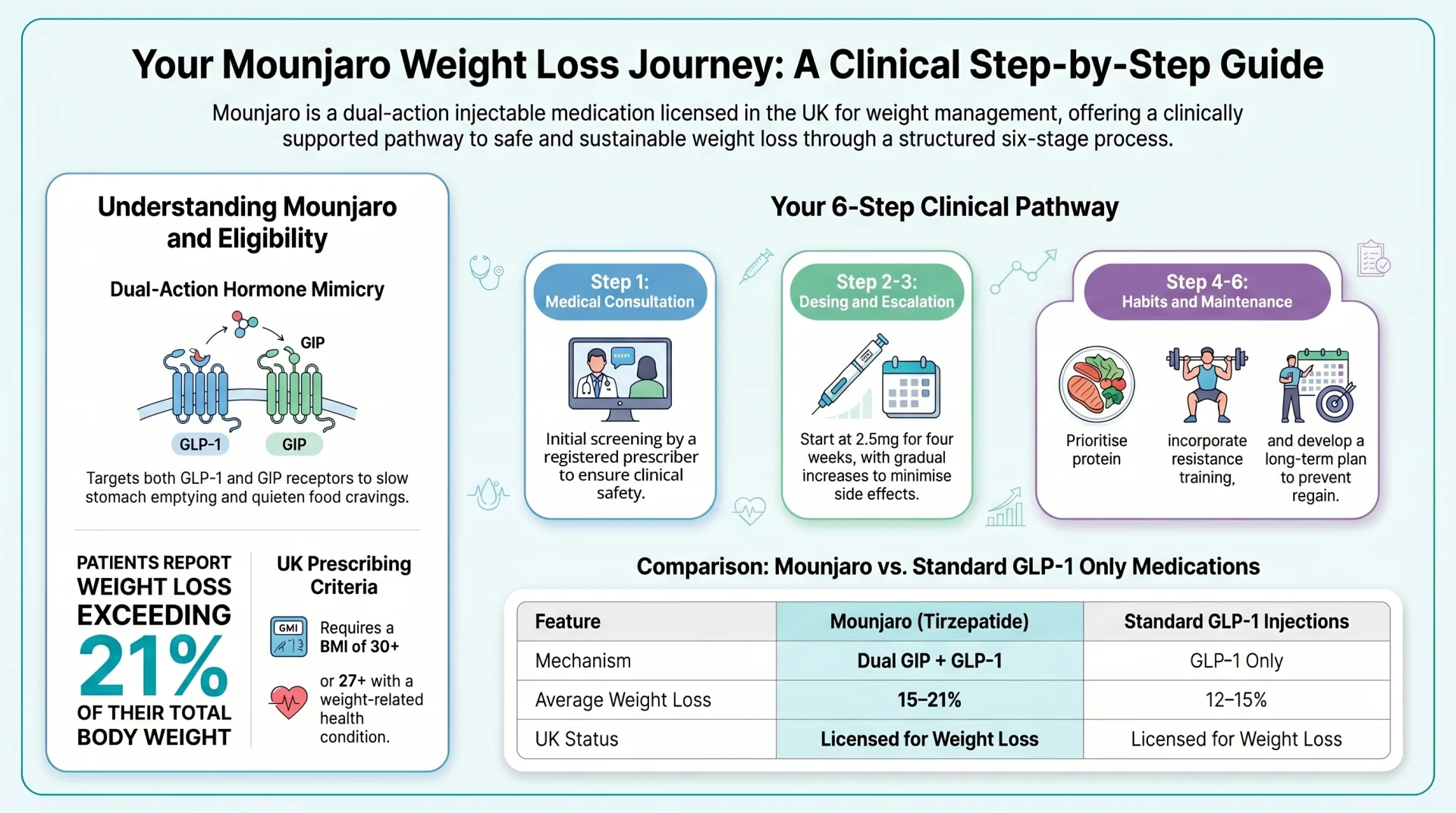
This is the section most people are here for. We've broken the Mounjaro (Tirzepatide) for beginners process into six clear steps based on what we see across hundreds of patients.
Step 1: Medical Consultation
Before anything else, you need a full clinical assessment. If you want to buy Mounjaro (Tirzepatide) UK prescription, that prescription must come from a registered prescriber a doctor, nurse prescriber, or pharmacist prescriber following a two way clinical consultation.
At a weight loss injections UK clinic like Weight Medics, this means:
- A full health screening including blood pressure, blood tests where appropriate, and a review of your medication list
- An honest discussion of your weight history, previous attempts, and what's driving your decision now
- Assessment of contraindications personal or family history of medullary thyroid carcinoma, history of pancreatitis, pregnancy, or breastfeeding
- Setting realistic expectations, because no medication works without context
- Agreement on a monitoring schedule going forward
Step 2: Starting Dose
The Mounjaro dosage schedule begins low. Almost always at 2.5 mg weekly. This isn't a therapeutic dose for weight loss — it's an introduction. Your body needs time to adjust.
During weeks one to four, the most common experiences are mild nausea (especially in the first few days after injection), reduced appetite that might feel subtle or dramatic depending on the person, some bloating or changes in bowel habits, and occasional fatigue as your body recalibrates.
only a small number about 1 in 10 of our patients experience nausea. For most, it passes within days. Eating smaller meals, staying hydrated, and avoiding greasy food makes a real difference here. We also recommend injecting in the evening so any nausea peaks while you sleep.
Weight loss at this stage? Usually modest. Maybe a kilo or two. Don't get discouraged this phase is about acclimatisation, not transformation.
Step 3: Dose Escalation
After four weeks, your prescriber will typically move you to 5 mg. This is where things genuinely start to shift.
The Mounjaro (Tirzepatide) weekly dosage plan for beginners follows a pattern: 2.5 mg for four weeks, then 5 mg for four weeks, then potentially up to 7.5 mg, 10 mg, 12.5 mg, or the maximum 15 mg. Each increase happens at minimum four-week intervals, and only if your clinician is satisfied you're tolerating the current dose well.
Not everyone needs the highest dose. I can't stress this enough. Some patients plateau at 7.5 mg and do beautifully. Others genuinely need 15 mg. This is why ongoing monitoring matters we've seen patients push for higher doses too quickly and spend weeks dealing with entirely avoidable side effects. Patience here pays off enormously.
The dose escalation phase is also where the question "how long does Mounjaro (Tirzepatide) take to work" gets its clearest answer: most people notice meaningful appetite changes within four to eight weeks, with visible weight loss following shortly after.
Step 4: Lifestyle Changes That Actually Stick
Here's the part that separates lasting results from temporary ones.
Mounjaro (Tirzepatide) reduces your appetite. It doesn't choose your meals. The patients who get the best Mounjaro (Tirzepatide) weight loss before and after outcomes are the ones who treat the reduced appetite as an opportunity, not a crutch. A window to build habits that'll serve them long after treatment ends.
What does that look like?
On diet: Prioritise protein at every meal. Aim for 1.2 to 1.6 grams per kilogram of body weight daily this protects lean muscle mass, which matters enormously as you lose weight. Eat vegetables in volume. Keep processed food low, not because it's "bad," but because it's easy to overeat even on medication. Stay in a moderate calorie deficit. You don't need to starve. Most of our patients thrive on 1,400 to 1,800 calories depending on their starting point.
On exercise: Resistance training twice a week is more important than cardio for long-term body composition. Full stop. Walking 7,000 to 10,000 steps daily is the simplest, most sustainable habit you can build. Add one or two cardio sessions if you enjoy them, but don't make the gym a punishment.
Step 5: Tracking Progress the Right Way
Weigh yourself once a week, same day, same time, same conditions. First thing in the morning after using the bathroom works best.
But here's what most people miss.
The scale lies. Or at least, it tells a wildly incomplete story. Water retention, hormonal fluctuations, bowel habits, time of month they all affect the number. We've had patients lose two inches off their waist in a month while the scale barely moved. If you're only watching the number, you'll get demoralised at exactly the wrong moment.
Track waist circumference, how your clothes fit, your energy levels, your sleep quality. Take photos monthly same outfit, same lighting, same angle. These markers often tell the truth long before the scale catches up.
Step 6: Long-Term Maintenance and Preventing Regain
This is where most weight loss stories fall apart. Not during treatment. After it.
Studies suggest that stopping GLP-1 receptor agonists without a maintenance plan leads to significant weight regain within 12 months for the majority of people. We've watched this happen, time and again. It's not a personal failure. It's biology. Your body's appetite signalling doesn't simply "reset" because you've lost weight.
Long-term strategies that work:
- Building protein and movement habits so deeply that they're automatic, not aspirational
- Considering a maintenance dose of medication (lower than your peak dose) in discussion with your clinician
- Having a clear plan for what to do if weight starts creeping back most people wait far too long to act
- Staying connected to clinical support, not just during the "active" phase
- Recognising that weight maintenance is its own skill, entirely different from weight loss
Mounjaro Results Timeline: What to Expect and When
This is the Mounjaro (Tirzepatide) results timeline we share with patients, based on clinical trial data and what we observe in practice.
Weeks 1 to 6: Early Changes
Appetite drops noticeably. You may lose 2 to 4 kg, sometimes more. Cravings ease. Food noise quiets down. This phase feels almost surreal for people who've spent years fighting hunger. I've had patients describe it as "hearing silence for the first time."
Weeks 8 to 12: Visible Fat Loss
Clothes start fitting differently. Others begin to notice. Average weight loss by this point is often 5 to 8% of starting body weight. Energy improves. Confidence builds.
Months 6 to 12: Significant Transformation
Clinical trials (SURMOUNT-1) show average weight loss exceeding 21% on the highest dose. In our experience, patients on moderate doses typically achieve 12 to 18%. That's 15 to 25 kg for someone starting at 120 kg.
These numbers are averages. Your results will depend on your dose, your adherence, your diet, your movement, and your starting point. Some patients exceed these figures. Others fall short. Both outcomes are completely normal.
Mounjaro Diet Plan for Best Results
You don't need a rigid meal plan. You need principles.
We've found five guidelines that consistently produce the best outcomes alongside tirzepatide:
- Protein first, always. Start every meal with your protein source -chicken, fish, eggs, Greek yoghurt, legumes, tofu. This preserves muscle and keeps you fuller longer.
- Eat slowly. Mounjaro (Tirzepatide) slows gastric emptying, so if you eat too fast, nausea follows. Twenty minutes per meal is a good target.
- Hydrate between meals, not during. Large volumes of fluid with food can worsen nausea and bloating. Sip throughout the day instead.
- Cut back on ultra-processed food. Not to zero, that's unrealistic for most people. But shifting even 30% of your ultra-processed intake toward whole foods makes a measurable difference.
- Don't skip meals. Your appetite will be lower, but consistently undereating leads to muscle loss, fatigue, and eventual bingeing. Aim for three structured meals even if portions are smaller.
A sample day might look like: scrambled eggs with spinach and sourdough toast for breakfast. A chicken and quinoa bowl with roasted vegetables for lunch. Salmon with sweet potato and green beans for dinner. Greek yoghurt with berries as a snack if needed.
Nothing revolutionary. That's the point.
Mounjaro Side Effects and Safety
Let's talk about Mounjaro (Tirzepatide) side effects weight loss patients actually experience, because the clinical trial list and real-world experience don't always line up neatly.
Common (affecting more than 1 in 10 people):
- Nausea, especially in the first two to four weeks and after dose increases
- Diarrhoea or constipation (sometimes alternating, which is every bit as frustrating as it sounds)
- Reduced appetite (this is partly the point)
- Mild abdominal discomfort
- Fatigue in the first few weeks
Less common but worth knowing:
- Acid reflux or heartburn
- Hair thinning — usually temporary, often linked to rapid weight loss and insufficient protein intake
- Gallstones, particularly with fast weight loss
Rare but serious (seek immediate medical attention):
- Signs of pancreatitis: severe abdominal pain radiating to the back
- Allergic reactions: swelling, difficulty breathing, rapid heartbeat
- Thyroid concerns: in animal studies, tirzepatide was associated with thyroid C-cell tumours. This hasn't been confirmed in humans, but patients with a personal or family history of medullary thyroid carcinoma shouldn't use this medication
Most side effects are manageable and transient. In our experience, patients who know what to expect handle the adjustment period far better than those who don't. Knowledge genuinely is the best anti-nausea tool we've got (well, that and ginger tea).
Mounjaro vs Wegovy : How Do They Compare?
The Mounjaro (Tirzepatide) vs Wegovy (semaglutide) question comes up in almost every consultation. Here's the honest breakdown.
| Feature | Mounjaro (Tirzepatide) | Wegovy (Semaglutide) |
| Mechanism | Dual GIP + GLP-1 | GLP-1 only |
| Licensed for weight loss (UK) | Yes (as of 2024) | Yes |
| Average weight loss in trials | 15–21% | 12–15% |
| Injection frequency | Weekly | Weekly |
| UK availability | Prescription only | Prescription only |
Mounjaro (Tirzepatide) consistently outperforms semaglutide-based treatments in head-to-head data. The SURMOUNT trials showed roughly 5 to 6 percentage points more weight loss compared with Wegovy (semaglutide) at similar timepoints. That's significant.
But "better on average" doesn't automatically mean better for you specifically.
Some patients respond brilliantly to semaglutide and poorly to tirzepatide, or vice versa. Why does this happen? Honestly, we don't fully understand yet and that's one of the frank limitations of this field that I think deserves more acknowledgement than it gets (and yes, we've seen this play out enough times in clinic to know it's real, not just statistical noise). This is why working with a Doctor-led weight loss clinic London patients can trust matters. The prescriber should be choosing based on your clinical profile, not writing a one-size prescription.
How Much Weight Can You Lose on Mounjaro ?
The honest answer: it depends.
Trial data from SURMOUNT-1 showed participants losing an average of 22.5% of body weight on the 15 mg dose over 72 weeks. That's roughly one-fifth of their starting weight — for a person weighing 100 kg, that's over 22 kg.
In clinical practice, results tend to be slightly lower than trial conditions, where adherence is closely monitored and diets are tightly controlled. We typically see 12 to 20% weight loss over 9 to 12 months, depending on the dose achieved and lifestyle changes made.
Some people lose more. We've had patients drop 30 kg in under a year. Others lose 8 to 10 kg and find that genuinely transformative for their health markers, even if it sounds modest on paper. A 10% weight loss can resolve sleep apnoea, normalise blood pressure, and dramatically improve joint pain.
The number on the scale isn't the whole picture. Not by a long way.
Tips to Maximise Your Mounjaro Results
After years of working with patients on this medication, these are the patterns that separate good outcomes from great ones:
Inject on the same day each week. Set a reminder. Consistency in timing means consistency in drug levels.
Don't chase the highest dose. If you're losing weight steadily on 7.5 mg, there's no rush to reach 15 mg. Higher doses mean more side effects without guaranteed proportional benefit.
Prioritise sleep. Poor sleep increases ghrelin (your hunger hormone) and undermines everything the medication is trying to do. Seven to eight hours makes a genuine difference. We've seen patients stall completely until they fixed their sleep — it's that powerful.
Get your protein up early in treatment. Don't wait until you've lost 10 kg to start worrying about muscle mass. By then, you've already lost some. Start from week one.
Stay in contact with your prescriber. A quick check-in when something feels off is worth more than a crisis appointment six weeks later.
Be honest about what you're eating. The medication isn't magic. If you're consuming 2,500 calories of takeaway most evenings, results will be limited regardless of dose. We'd rather hear the truth and help you problem-solve than see you quietly frustrated.
Start Your Mounjaro Weight Loss Process with Weight Medics
If you've read this far, you're serious. That matters.
Weight Medics is a Doctor-led weight loss clinic London and UK-wide patients choose because we don't just hand over a prescription and wish you well. We screen properly, monitor consistently, adjust doses based on your response, and support the lifestyle changes that make the medication work long-term.
Your Mounjaro (Tirzepatide) weight loss process doesn't start with an injection. It starts with a conversation. Book a consultation with our clinical team and find out whether tirzepatide is the right fit for your body, your health, and your goals.
We'll be straight with you. Always.
What's a Mounjaro (Tirzepatide) weight loss process?
A Mounjaro (Tirzepatide) weight loss process refers to the full journey of using tirzepatide (Mounjaro (Tirzepatide)) for weight management — from your initial medical consultation and health screening, through dose titration, lifestyle changes, and long-term maintenance. It's not just about the injection itself. It includes dietary adjustments, exercise habits, regular monitoring with a clinician, and building sustainable routines that prevent weight regain after treatment.
How do I start Mounjaro (Tirzepatide) step by step?
Book a consultation with a registered prescriber. They'll assess your BMI, health history, and suitability. If you're approved, you'll start on 2.5 mg weekly, increase gradually every four weeks based on tolerance, and combine the medication with protein-focused nutrition and regular movement. The whole process is designed to be gradual — there's no rushing it safely.
What should I expect in my first month on Mounjaro (Tirzepatide)?
Reduced appetite, possible nausea for the first week or two, and modest weight loss of 1 to 4 kg. Your starting dose of 2.5 mg is an introductory dose designed to let your body adjust. Energy levels may dip initially before stabilising — most patients feel back to normal by week three or four.
What are typical Mounjaro (Tirzepatide) results week by week?
Weeks one to two: appetite reduction begins, mild nausea possible. Weeks three to four: nausea usually resolves, 1 to 2 kg lost. Weeks five to eight (after dose increase to 5 mg): more noticeable appetite suppression, 3 to 5 kg total lost. Weeks nine to twelve: visible changes in body shape, clothes fitting differently, 5 to 8% of starting weight lost for most patients. After twelve weeks, the rate of loss continues but may slow slightly as your body adapts. Consistent results over six to twelve months typically range from 12 to 20% of starting body weight, depending on dose, diet, and activity levels.
Can beginners use Mounjaro (Tirzepatide) safely?
Absolutely. The Mounjaro (Tirzepatide) dosage schedule is specifically designed for beginners, starting at the lowest dose (2.5 mg) and increasing gradually. The medication has been through rigorous clinical trials and is approved by the MHRA for use in the UK. Safety depends on proper prescribing — a qualified clinician must assess your health before starting treatment, and ongoing monitoring ensures any side effects are caught and managed early. It isn't suitable for everyone (pregnancy, certain thyroid conditions, and a history of pancreatitis are contraindications), which is exactly why the medical consultation step exists. No shortcuts.
- What Is Mounjaro and How Does Mounjaro Work?
- Who Is a Good Candidate for Mounjaro?
- Your Step-by-Step Mounjaro Process
- Mounjaro Results Timeline: What to Expect and When
- Mounjaro Diet Plan for Best Results
- Mounjaro Side Effects and Safety
- Mounjaro vs Wegovy : How Do They Compare?
- How Much Weight Can You Lose on Mounjaro ?
- Tips to Maximise Your Mounjaro Results
- Start Your Mounjaro Weight Loss Process with Weight Medics